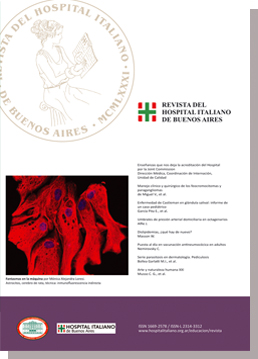
Manejo clínico y quirúrgico de los feocromocitomas y paragangliomas
DOI:
https://doi.org/10.51987/Rev.Hosp.Ital.B.Aires.v35i3.710Palabras clave:
feocromocitoma, paraganglioma, tumores neuroendocrinos, hipertensión, incidentaloma, catecolaminas, metanefrinas, adrenalectomía, malignidad, genéticaResumen
Los feocromocitomas y paragangliomas (Feo/PGL) son tumores neurendocrinos raros con diferentes presentaciones clínicas, asociados a alta morbimortalidad. Reconocer los signos y síntomas es el paso diagnóstico inicial. Las metanefrinas fraccionadas urinarias tienen una excelente sensibilidad y especificidad. La tomografía computarizada (TC) es el método de elección para su localización. La tomografía por emisión de positrones (PET) con F18-fluordeoxiglucosa (F18-FDG) es el método funcional recomendado para detectar metástasis. La resección quirúrgica constituye la única opción curativa en estos pacientes. La adrenalectomía laparoscópica es la vía de abordaje para la mayoría los Feo/PGL. El tratamiento farmacológico, 7 a 14 días previos con alfabloqueantes y betabloqueantes, tiene como objetivo normalizar la presión arterial y prevenir complicaciones cardiovasculares periquirúrgicas. Se conoce que al menos un tercio de los pacientes presentan una mutación genética germinal. El estudio genético debe estar orientado a las características sindrómicas, formas de presentación, localización y fenotipo bioquímico del tumor. Se recomienda el abordaje interdisciplinario en centros especializados con experiencia en esta patología poco frecuente
Descargas
Referencias
Pacak K, JDR. Pheochromocytoma and Paraganglioma [Internet]. Available from: http://www.endotext.org/chapter/pheochromocytoma
Kirmani S, Young WF. Hereditary Paraganglioma-Pheochromocytoma Syndromes. Seattle: University of Washington; 2014.
van Berkel A, Lenders JW, Timmers HJ. Diagnosis of endocrine disease: Biochemical diagnosis of phaeochromocytoma and paraganglioma. Eur J Endocrinol. 2014;170(3):R109-19. DOI: https://doi.org/10.1530/EJE-13-0882
Mantero F, Terzolo M, Arnaldi G, et al. A survey on adrenal incidentaloma in Italy. Study Group on Adrenal Tumors of the Italian Society of Endocrinology. J Clin Endocrinol Metab. 2000;85(2):637-44. DOI: https://doi.org/10.1210/jc.85.2.637
Mannelli M, Lenders JW, Pacak K, et al. Subclinical phaeochromocytoma. Best Pract Res Clin Endocrinol Metab. 2012;26(4):507-15. DOI: https://doi.org/10.1016/j.beem.2011.10.008
Motta-Ramirez GA, Remer EM, Herts BR, et al. Comparison of CT findings in symptomatic and incidentally discovered pheochromocytomas. AJR Am J Roentgenol. 2005;185(3):684-8. DOI: https://doi.org/10.2214/ajr.185.3.01850684
Lenders JW, Duh QY, Eisenhofer G, et al. Pheochromocytoma and paraganglioma: an endocrine society clinical practice guideline. J Clin Endocrinol Metab. 2014;99(6):1915-42. DOI: https://doi.org/10.1210/jc.2014-1498
Fuxe K, Manger P, Genedani S, et al. The nigrostriatal DA pathway and Parkinson’s disease. J Neural Transm Suppl. 2006;(70):71-83. DOI: https://doi.org/10.1007/978-3-211-45295-0_13
Pacak K, Lenders JWM, Eisenhofer G. Pheochromocytoma Diagnosis, Localization, and Treatment. Malden, MA: Blackwell Publishing; 2007. (http://www.wiley.com/WileyCDA/Wiley Title/productCd-1405149507.html ) DOI: https://doi.org/10.1002/9780470692196
Young WF, NM K. Clinical presentation and diagnosis of pheochromocytoma. UpToDate. 2015. http://www.uptodate.com/contents/clinical-presentation-and-diagnosis-of-pheochromocytoma
Baid SK, Lai EW, Wesley RA, et al. Brief communication: radiographic contrast infusion and catecholamine release in patients with pheochromocytoma. Ann Intern Med. 2009;150(1):27-32. Erratum in: Ann Intern Med. 2009 Feb 17;150(4):292. DOI: https://doi.org/10.7326/0003-4819-150-1-200901060-00006
Taïeb D, Varoquaux A, Chen CC, et al. Current and future trends in the anatomical and functional imaging of head and neck paragangliomas. Semin Nucl Med. 2013;43(6):462-73. DOI: https://doi.org/10.1053/j.semnuclmed.2013.06.005
Castinetti F, Kroiss A, Kumar R, et al. 15 YEARS OF PARAGANGLIOMA: Imaging and imaging-based treatment of pheochromocytoma and paraganglioma. Endocr Relat Cancer. 2015;22(4):T135-45 DOI: https://doi.org/10.1530/ERC-15-0175
Pacak K. Preoperative management of the pheochromocytoma patient. J Clin Endocrinol Metab. 2007;92(11):4069-79. DOI: https://doi.org/10.1210/jc.2007-1720
Prejbisz A, Lenders JW, Eisenhofer G, et al. Cardiovascular manifestations of phaeochromocytoma. J Hypertens. 2011;29(11):2049-60. DOI: https://doi.org/10.1097/HJH.0b013e32834a4ce9
Zuber SM, Kantorovich V, Pacak K. Hypertension in pheochromocytoma: characteristics and treatment. Endocrinol Metab Clin North Am. 2011;40(2):295-311, vii. DOI: https://doi.org/10.1016/j.ecl.2011.02.002
Lebuffe G, Dosseh ED, Tek G, et al. The effect of calcium channel blockers on outcome following the surgical treatment of phaeochromocytomas and paragangliomas. Anaesthesia. 2005;60(5):439-44 DOI: https://doi.org/10.1111/j.1365-2044.2005.04156.x
Descargas
Compartir artículo
Publicado
Número
Sección
Licencia
Derechos de autor 2015 Revista del Hospital Italiano de Buenos Aires

Esta obra está bajo una licencia internacional Creative Commons Atribución-NoComercial-CompartirIgual 4.0.