
Editorial de la revista número 1 del año 2020
Article Sidebar
Main Article Content
Abstract
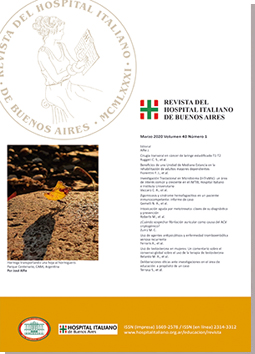
In recent years, the surgical treatment of laryngeal cancer has evolved from external surgery toward transoral surgery. Carlos Santiago Ruggeri and collaborators from the Department of Otolaryngology present a prospective study describing their experience in 103 patients treated for early-stage laryngeal cancer (T1–T2) with transoral surgery.
After the acute phase of the disease has been overcome, Intermediate Care Units (IMCUs) aim to achieve patients’ functional recovery and reintegration into the community. Fernando Javier Fiorentini and Gastón Perman, from the Department of Internal Medicine, evaluated the characteristics of patients admitted to the IMCU with rehabilitation goals and the functional gains achieved after the intervention.
Approximately 100 trillion microorganisms reside in our intestine, and their genetic material is 100 times greater than that of the human genome. Translational research in the microbiome (InTraMic) is one of the lines of research developed at the Institute of Translational Medicine and Biomedical Engineering. Carlos A. Vaccaro and collaborators describe the different research lines they are developing.
Zygomycosis is a fungal infection with poor prognosis that affects immunocompromised patients. Nicolás A. Gemelli and collaborators, from the Adult Intensive Care Unit and the Department of Otolaryngology, present a clinical case of a 40-year-old immunocompetent man with mucormycosis and hemophagocytic syndrome who developed multiorgan failure.
Methotrexate (MTX) is a folic acid antagonist. Michelle Roberts and collaborators from the Department of Dermatology illustrate the mucocutaneous manifestations of MTX intoxication that developed within only one week.
Cryptogenic or undetermined ischemic stroke accounts for approximately 25% of all strokes. María Cristina Zurrú, from the Department of Neurology, discusses when atrial fibrillation should be suspected as the cause of a cryptogenic stroke.
Augusto Ferraris, from the Department of Internal Medicine, comments on his publication that evaluated the impact of incident antipsychotic use on the risk of recurrent venous thromboembolic disease (VTE). He found that in elderly patients receiving anticoagulant therapy, the use of first- and second-generation antipsychotics was not associated with an increased risk of recurrent VTE.
María Alejandra Belardo and Paula Canet Marchevsky, from the Menopause Section of Hospital Italiano de Buenos Aires and the Department of Obstetrics and Gynecology of Hospital Luis Lagomaggiore in Mendoza, evaluate testosterone supplementation in female sexual dysfunction.
Sergio Terrasa and Débora Szeinman, from the Department of Family and Community Medicine, the Research Department, and the Department of Public Health of the University Institute, reflect on the ethical dilemmas faced by research in education.
Downloads
Article Details
Section

This work is licensed under a Creative Commons Attribution-NonCommercial-ShareAlike 4.0 International License.