
Editorial de la revista número 1 del año 2017
Article Sidebar
Main Article Content
Abstract
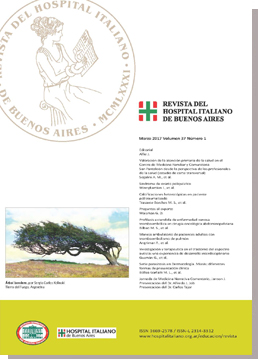
Agustín M. Segalini, from the Department of Family and Community Medicine, evaluates the quality of primary health care in a Family and Community Medicine Center in the San Isidro district.
Polycystic ovary syndrome is the main cause of hyperandrogenism. Irina Winnykamien, from the Department of Endocrinology, Metabolism, and Nuclear Medicine, reviews the pathophysiology, diagnostic criteria, treatment of hyperandrogenism, menstrual disorders, infertility, and management of its multiple comorbidities.
In the Internal Medicine in Imaging section, María Soledad Trasante Borches from the Department of Internal Medicine describes the radiological, topographic, and scintigraphic images in a patient who developed heterotopic ossification of the psoas and adductor muscles, and of the hip joints, as a late complication of polytrauma.
In the new section Questions to the Expert, Gabriel Waisman, head of the Department of Internal Medicine, answers questions about the blood pressure target and the pros and cons of intensifying antihypertensive treatment in elderly patients with diabetes.
In the Hospital Italiano in Medline section, Maria Soledad Bilbao and Carlos Vaccaro, from the Department of Surgery, comment on their publication in Clin Appl Thromb Hemost, which discusses adherence to extended thromboprophylaxis in elderly patients recovering from abdominopelvic oncologic surgery.
The Pediatric Mental Health Service and the Department of Biomedical Engineering at the Instituto Universitario del Hospital Italiano developed an application called Apptea, for touchscreen tablets, as a tool to promote expressiveness, attention, and social interaction in children with autism spectrum disorders. Guido Guzmán, from the Laboratory of Biological and Artificial Learning, reports on the use of technological tools in the treatment of these children.
Myiasis is an infestation by developing larvae. In the Dermatology Parasitosis Series, María Luz Bollea Garlatti from the Department of Dermatology presents a series of three cases illustrating the furunculoid and cavitary varieties of myiasis.
Narrative medicine is a healthcare communication tool that strengthens empathy with patients. In September 2016, the Hospital Italiano held the IV Narrative Medicine Conference, “The Voices of Health.” Two of the panelists who participated in the Doctors as Writers session, Alfredo J. Job, Deputy Chief of Psychiatry at Hospital Italiano, and Carlos Tajer, former President of the Argentine Society of Cardiology, along with coordinator Jorge Janson, provide a review of their presentations
Downloads
Article Details
Section

This work is licensed under a Creative Commons Attribution-NonCommercial-ShareAlike 4.0 International License.