
Editorial de la revista número 4 del año 2016
Article Sidebar
Main Article Content
Abstract
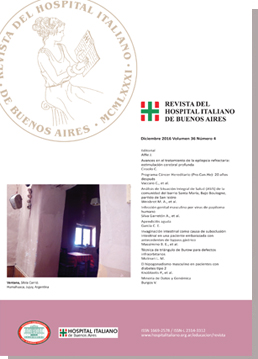
The Hereditary Cancer Program celebrated its 20th anniversary. Carlos Vaccaro and María L. González provide a historical overview of this institutional interdisciplinary program for the prevention and treatment of hereditary forms of cancer, officially created in 1996.
In May 2016, for the first time in Latin America, a stimulator was implanted in the anterior thalamic nucleus of a patient with bilateral mesial temporal focal epilepsy resistant to medical treatment. Carlos Ciraolo explains the procedure of deep brain stimulation through electrodes, which, when placed in the seizure onset region or related areas, reduces the frequency of seizures in patients with refractory epilepsy.
Mariela Alejandra Weisbrot presents the results of a randomized household survey conducted in the Santa María neighborhood of the San Isidro district, which investigated the health needs of the community.
Human papillomavirus (HPV) is one of the most common sexually transmitted diseases. Alejandro Silva Garretón reviews the diagnosis, treatment options, and prevention of male genital HPV infection.
Growing evidence supports the treatment of uncomplicated acute appendicitis with antibiotics. Based on a case of acute appendicitis resolved with antibiotic therapy, Carlos E. García discusses this therapeutic option.
Intestinal intussusception is an uncommon cause of intestinal obstruction in adults and is exceptional in pregnant women. Brenda Estefanía Massimino presents the computed tomography of a pregnant woman complicated with jejuno-jejunal intussusception.
The Hospital Italiano in Medline section includes commentary on two publications. Leisa M. Molinari highlights the lower risk of ectropion when using the Burow triangle technique for the closure of defects involving the infraorbital area.
Patients with type 2 diabetes have a higher prevalence of hypogonadism than non-diabetic patients. Pablo Knoblovits and Pablo R. Costanzo analyze the mechanisms involved in the reduction of androgen levels in patients with type 2 diabetes.
The rapid and efficient processing of massive computerized patient data allows for the discovery of relevant patterns or associations that are not evident with traditional analytical methods. Valeria Burgos, from the Laboratory of Biological and Artificial Learning, introduces the process of Data Mining applied to genomic medicine.
Downloads
Article Details
Section

This work is licensed under a Creative Commons Attribution-NonCommercial-ShareAlike 4.0 International License.